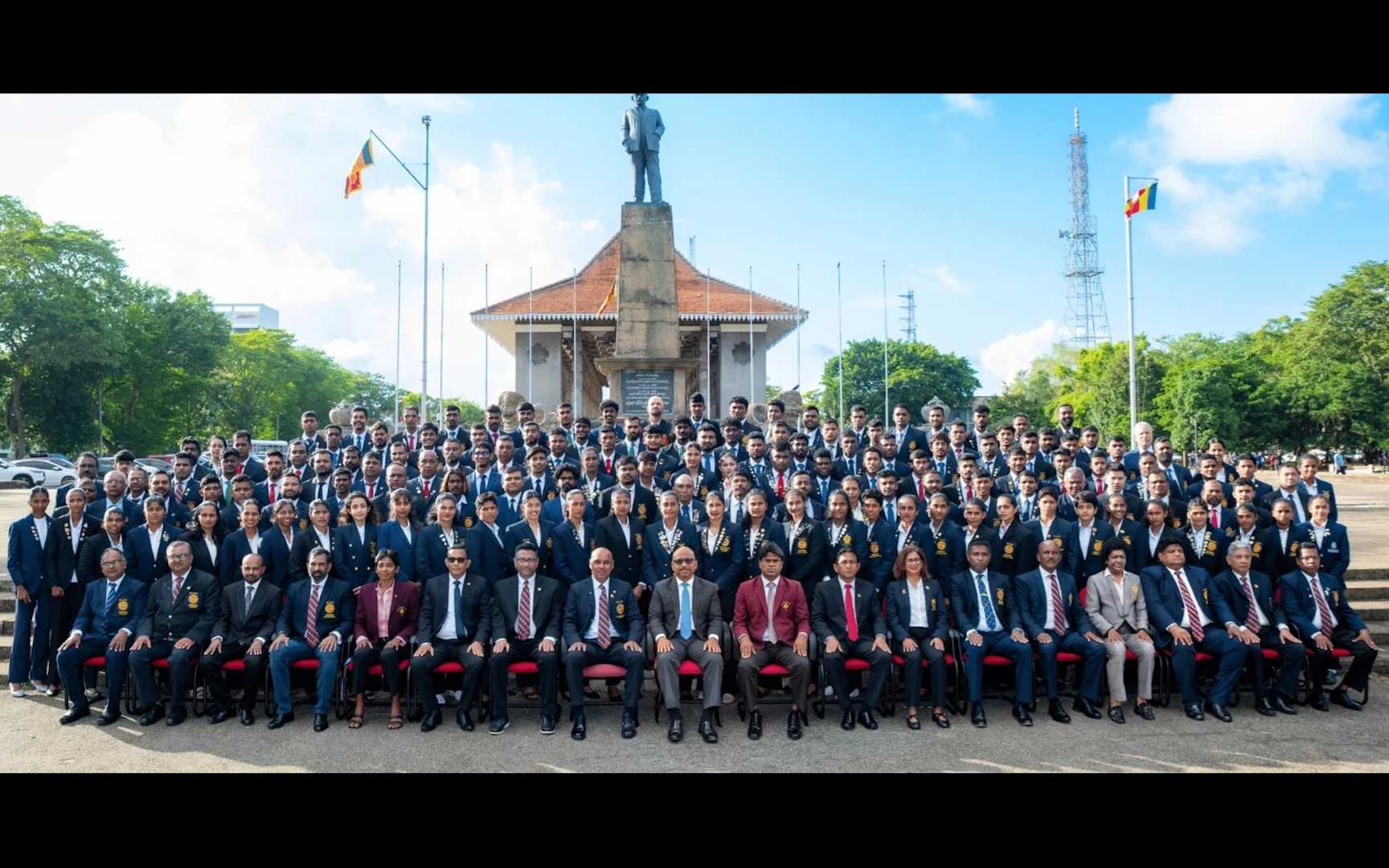
"VAN" (Sports Desk - 17.09.2026) :: Sri Lanka will take a 156-strong athlete contingent to the Asian Games in Aichi-Nagoya, Japan, with 100 male and 56 female athletes representing the country across 25 sports disciplines.
The scale and diversity of the contingent reflect an increasingly broad sporting landscape, with Sri Lankan athletes set to compete in disciplines ranging from athletics, cricket and rugby to surfing, modern pentathlon, 3x3 basketball and beach volleyball.
The Asian Games will provide a demanding examination of Sri Lanka’s sporting capabilities, bringing its athletes into direct competition with some of the most established high-performance systems in the continent.
For Sri Lanka, the challenge is not confined to the podium. The Games provide an opportunity to assess the progress of individual athletes, the competitiveness of national teams and the depth being developed across a wider range of sports.
Tharanga carries considerable attention
Within the contingent, javelin thrower Rumesh Tharanga will command particular attention following an exceptional international season.
Tharanga has emerged as one of the world's leading javelin throwers, producing a series of outstanding performances in 2026, including throws beyond 90 metres. His performances in Rome and Zurich, followed by his success at the Diamond League Final, have significantly elevated his international standing.
His preparation for Nagoya has nevertheless encountered an unusual setback as several of his competition javelins were damaged during air transportation, on his return from the World Athletics Ultimate Championship in Budapest, two days after becoming the Ultimate champion in his sport.
The equipment issue presents an additional challenge, but Tharanga's recent performances provide a strong indication of his competitive level. His appearance in Nagoya will also be closely followed internationally as he attempts to translate his exceptional season into another major championship performance.
While athletics has historically been one of Sri Lanka's principal strengths at the Asian Games, the country's representation this time extends considerably beyond the track and field arena.
Cricket remains a key component
Cricket will attract substantial attention, particularly given Sri Lanka's established position within Asian cricket.
The T20 format provides an opportunity for the country's men's and women's teams to demonstrate their adaptability and depth against strong regional opposition. For emerging players, the tournament also represents an important international platform outside the conventional bilateral and ICC competition structure.
Rugby and hockey face demanding contests
Rugby Sevens will provide one of the most physically demanding team challenges. The compressed format requires exceptional conditioning, rapid decision-making and tactical discipline, with relatively little margin for error.
Sri Lankan rugby has considerable experience in Asian competition, and Nagoya will provide another opportunity to measure that programme against the continent's leading teams.
Hockey faces a similarly demanding environment. Sri Lanka will be competing in a discipline dominated by countries with extensive development structures and deep player pools, making every match a significant test of organisation and execution.
Combat sports offer individual opportunities
Sri Lanka's representation in Boxing, Judo, Wushu, Karate, Taekwondo and Wrestling adds considerable strength to the overall sporting programme.
These disciplines place a premium on technical preparation, tactical awareness and psychological resilience. Tournament draws can also play an important role, with athletes required to maintain performance through successive rounds against opponents with different styles and levels of experience.
Weightlifting will provide another demanding examination, requiring precision as well as physical strength, while Archery will test consistency and concentration under intense competitive conditions.
Water sports reflect Sri Lanka’s geographical advantages
The country's participation in Swimming and Diving, Rowing, Sailing and Surfing provides another important dimension to the contingent.
Sri Lanka's extensive coastline has helped create a natural environment for the development of water sports, with surfing in particular offering an area of growing international interest.
The Asian Games, however, represent a substantial step up in competition. Participation against established Asian programmes will provide Sri Lankan athletes and administrators with valuable information about the technical, physical and institutional requirements necessary to progress at the highest level.
Racquet sports and emerging disciplines
Badminton, Table Tennis and Squash will place Sri Lankan athletes against some of Asia's strongest racquet-sport nations. Countries such as China, Japan, South Korea and India possess highly developed systems in these disciplines, making the competition an important benchmark for Sri Lankan players.
Artistic Gymnastics will demand exceptional technical precision, while Golf provides another opportunity for Sri Lankan competitors to gain experience in a highly competitive international field.
Meanwhile, the inclusion of Basketball 3x3, Kabaddi, Beach Volleyball and Modern Pentathlon demonstrates the changing composition of Sri Lanka's high-performance programme.
These disciplines represent an opportunity to broaden the country's sporting base and expose athletes to international standards that can help shape future development.
Beyond the results
Sri Lanka's participation in 25 sports — Aquatics, Archery, Artistic Gymnastics, Judo, Rowing, Rugby Sevens, Table Tennis, Squash, Weightlifting, Wrestling, Basketball 3x3, Wushu, Kabaddi, Beach Volleyball, Athletics, Boxing, Karate, Sailing, Taekwondo, Surfing, Badminton, Cricket, Golf, Modern Pentathlon and Hockey — represents a substantial commitment to participation across the Asian sporting landscape.
The immediate focus will naturally be on performances and results. But the longer-term value of Nagoya will be measured by what the country can take from the experience.
For established athletes such as Rumesh Tharanga, it is an opportunity to confirm their standing at the highest level of Asian competition. For younger competitors, it is an opportunity to gain exposure that cannot be replicated through domestic competition.
The 156 athletes therefore arrive in Japan with different objectives but a common responsibility: to represent Sri Lanka at one of the continent's most demanding sporting events.
Nagoya will provide a clear picture of where Sri Lankan sport currently stands — and, perhaps more importantly, where it needs to go next.
Cr - AIPS
Responses
Leave your comment