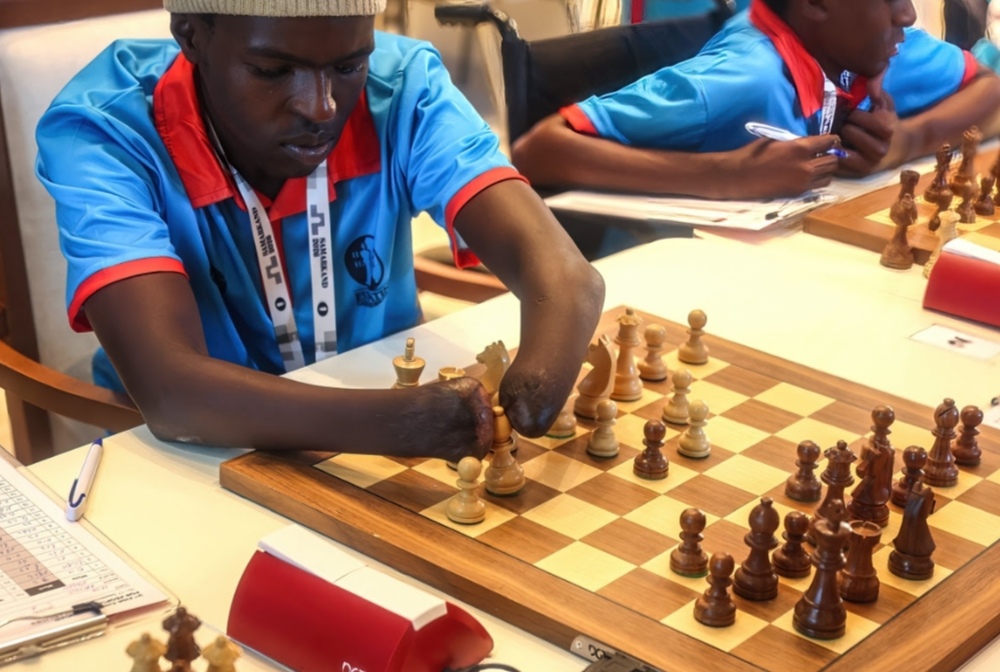
"VAN" (Sports Desk - 13.09.2026) :: Round 2 of the 3rd FIDE Chess Olympiad for People with Disabilities brought another day of competitive chess to Samarkand, with eight teams maintaining perfect records and setting up four direct clashes between the leaders in Round 3.
Beyond the results, the day once again highlighted the stories behind the players: childhood games with parents, lifelong friendships built through chess, the opportunity to represent one’s country, and the importance of bringing players with different disabilities together on the same stage.
Ceremonial first move opens Round 2
Round 2 began with the ceremonial first move by Thomas Luether, Chairperson of the FIDE Commission for Players with Disabilities and Chairperson of the Appeals Committee of the FIDE Chess Olympiad for People with Disabilities, and Khusen Mirzaevich Tukhtaev, Deputy Governor of Samarkand Region for Youth Policy, Social Development, and Spiritual and Educational Affairs.
Eight teams on a perfect four match points
Several of the leading teams produced convincing victories in Round 2.
Cuba defeated Serbia 3–1, while Israel overcame Ukraine by the same score. IBCA recorded a commanding 3½–½ victory over Switzerland, and Germany beat Kazakhstan 3–1.
The Philippines continued their strong start with a 3–1 win over Hungary, while the Czech Republic defeated Kyrgyzstan 3–1. India scored one of the biggest victories among the leaders, beating Uzbekistan 3 by 3½–½, while Argentina defeated Spain 3–1.
After two rounds, the Philippines, Cuba, Israel, Argentina, Czech Republic, IBCA, India and Germany lead the tournament with a perfect four match points each.
Leaders collide in Round 3
The third round promises to be particularly important, with all eight leaders facing each other across the top four boards.
On Board 1, the Philippines will take on Cuba, with both teams having collected 6½ game points from their opening two matches.
Israel, also on 6½ game points, is pitted against Argentina on Board 2. On Board 3, the Czech Republic will face IBCA, while India and Germany complete the clashes between the leaders on Board 4.
The top four Round 3 pairings are:
Philippines – Cuba
Israel – Argentina
Czech Republic – IBCA
India – Germany
With all eight teams entering Round 3 on four match points, the direct encounters will begin to separate the field at the top of the standings.
“When I play chess, I forget everything else”
While the competition intensified, the players continued to share the personal stories that brought them to Samarkand.
For Lila Mohamed Amin of Egypt, chess has been part of her life almost from the beginning. She started playing at just four years old after being introduced to the game by her father.
“My father taught me. He used to play chess with us when we were young, and when he realised that we were good at it, he found a coach to train us,” Amin explained.
Chess remained a family affair. Her brother also plays and has since become a coach.
“So we are really a chess family,” she said.
Amin believes chess has also influenced the way she approaches challenges beyond the board, helping her solve problems and think differently.
“I have a problem with my leg, but it doesn’t affect my chess. When I play a game of chess, I forget about everything else.”
Her team enjoyed a perfect afternoon on the boards as Egypt defeated Kenya 4–0.
Amin is participating in the Olympiad for the second time, but Samarkand offers a new experience. With the main Chess Olympiad beginning in the same city in the coming days, she is particularly excited about having some of the world’s leading players nearby.
“I’m very excited to see so many top chess players here. It’s my first time experiencing the main Chess Olympiad alongside our event, so I’m really excited.”
Argentina continue their strong start
For Santiago Jose Curia, Day 2 brought both a 3–1 victory over Spain and another successful step in Argentina’s perfect start to the competition.
“I’m very happy to be here. Representing Argentina is very important to me and to our whole team,” Curia said.
Having previously participated in the Olympiad in Astana, he is discovering Uzbekistan for the first time and described Samarkand as a beautiful and historic city.
His own chess journey also began with his father.
“I learned to play chess from my dad. He taught me how to move the pieces, and then I joined my first chess club, Jaque Mate.”
He later moved to Club Argentino, where playing with friends and competing in tournaments helped him develop further. But over the years, chess became far more than simply a hobby.
“Chess is my hobby, but it is also a very big part of my life. I have been playing since I was a child, and many of the decisions I’ve made in my life have been connected to chess.”
Argentina’s two victories have earned them four match points and a place among the eight leaders. Their next test will come immediately: Israel await them on Board 2 in Round 3.
“That is what inclusion is about”
Cristian Gonzalez Astete of Chile also had reason to celebrate after his team defeated Panama 3–1. For Gonzalez Astete, however, the importance of the Olympiad extends far beyond results.
“One of the most beautiful things here is that we have people with different kinds of disabilities competing together – players with physical disabilities, players who cannot see and players who cannot hear,” he said.
“We are all here together, competing in the same tournament. It’s a beautiful opportunity to meet people and share our experiences. That is what inclusion is about.”
He also welcomed the decision to stage the Olympiad for People with Disabilities in the same host city and period as the main Chess Olympiad.
“For us, it is particularly meaningful that both Olympiads are being brought together in the same place. It creates a feeling of equality, and that is very important.”
“You never forget your first love”
Gonzalez Astete‘s sporting story stretches beyond the chessboard. He is also a competitive table tennis player and represented Chile at Tokyo 2020, an experience he described as “amazing.” Balancing two sports at a high level is difficult, but chess occupies a unique place in his life. He first learned the game at around 12 years old from his father, and some of his strongest memories are of the time they spent together over the board. As he grew older, Gonzalez Astete continued playing at university and through different stages of his life.
“Chess has always been with me,” he said. “That’s one of the reasons I’m here today.”
His chess coach once gave him a phrase that still defines his relationship with the game:
“You never forget your first love. For me, that first love is chess.”
More than the points on the scoreboard
After two rounds, the sporting picture in Samarkand is beginning to take shape. Eight teams remain perfect, and Round 3 will guarantee movement at the top as the leaders meet directly across the first four boards. But the second day also demonstrated why the Olympiad extends beyond scores and standings.
With players with different disabilities competing together, and with the main Chess Olympiad soon bringing many of the world’s leading players to the same city, Samarkand is becoming a meeting point not only for competitive chess but also for stories, friendship, inclusion, and a shared passion for the game.
Responses
Leave your comment