"VAN" (Sports Desk - 19.05.2026) :: Participants of the AIPS Congress held in April in Lausanne had an intense schedule. Not to mention the elections, there were football games, the important AIPS Sport Media Awards ceremony, as well as visits to international entities that govern sport.
Perhaps one of the major highlights of the significant institutional visits was the meeting with the president of the International Volleyball Federation (FIVB), the Brazilian Fabio Azevedo – and for a very simple reason: Fabio made a point of welcoming all the congress participants, who were divided into three large groups, at the entrance of Château Les Tourelles, the organization’s headquarters.
After giving a tour of the facilities – including telling stories about the beautiful castle that serves as headquarters and workplace – Fabio led the visitors to the large hall where FIVB meetings are held and politely answered all the questions that were asked. In some cases, he spent more than two hours (that's right, more than two hours) fielding questions from the journalists – without leaving any question unanswered. Pure, intense sports journalism, with credibility and nothing to hide.
Days later, while preparing the meeting of the FIVB Board of Administration, which took place on 7 and 8 May at Volleyball House, Fabio agreed to be interviewed once again on various topics. More than an interview, this friendly conversation reveals a little more about this leader. Nothing, again, went unanswered: the development of the sport, gender equality (including the controversial issue of the participation of trans athletes), his time in charge of the FIVB... A conversation between friends that will now be reproduced for all other friends on the planet.
AIPS - How did your connection with volleyball begin? Did you expect to become president of the FIVB?
Fabio Azevedo - At the 1984 Los Angeles Olympic Games, at the age of 13, during that incredible campaign where Brazil won the silver medal, the first in the history of the sport in our country. Since then, I have always followed volleyball, clubs and national teams, and I have always dreamed of working professionally with the sport. During my first years of college, a volleyball professor recommended me to work in the statistics group of the Superliga (the Brazilian championship), which ended up being my first job in volleyball. From statistician I became an intern, and then an employee of the CBV – Brazilian Volleyball Confederation, starting to work in the Superliga production team, in the marketing agency called SportsMedia, and from there to Production Coordinator of the Superliga. From there, and literally going through all areas, I was COO/CEO of CBV for a long time, and in 2013 I became CEO of the International Volleyball Federation – FIVB for 12 years, and now president for a year and a half. That's almost 4 decades working for volleyball. I didn't expect to become president, I never planned to become president, since I've always been a sports executive, a professional. I decided to run for office to serve the sport, to ensure that the legacy continues, that volleyball continues to evolve, but a non-executive position was never part of my personal ambition. But I can say that today I am an executive Chairman of the FIVB Board of Directors, so much more than just a Chairman, just a President, I am also an executive, working shoulder to shoulder with the FIVB CEO, Hugh McCutcheon.
AIPS – Volleyball is one of the sports that undergoes the most changes, always seeking to increase public involvement. Do you consider this positive for those who are not fans of the sport?
FA - Of course, super positive. The sport is made for the athletes and the fans, and the fans need to understand the sport in order to follow it. Rule changes are always meant to eliminate the subjectivity of the sport, to make it more understandable and, ultimately, to increase the integrity of the game. So, rule changes, as long as they are apolitical and aimed at benefiting the athletes and the public, I believe are always positive.
AIPS - As you said, the prize money for women is the same as for men - and women, in several countries, are even better paid than men. Is this promotion of gender equality a policy of the organization?
FA - Without a doubt. One of the strengths of volleyball is having women's and men's volleyball at the same level of attractiveness, audience and interest. We here at the FIVB, when we organize a men's event and a women's event, know that they do, in fact, receive the same attention, the same care, the same professionalism. These events are, once again, aimed at the public and directed at the athletes, and we make no distinction.
AIPS - Regarding the IOC's issue concerning transgender athletes... What is the FIVB's position?
FA - We believe that everyone, regardless of gender, has the right to practice sports and must have the right to participate in volleyball, or beach volleyball. The only issue we defend, and will not compromise on, is the lack of competitive advantage: it cannot be due to a change in gender that this athlete, or this athlete, can have any type of competitive advantage within the sport. Here, we are open to any type of gender declaration as long as there is no competitive advantage. So the issue is purely a defense of women's sports so that there is no type of unfair competitive advantage.
AIPS - Today, how many national entities are affiliated with the FIVB? Where is there greater popular participation?
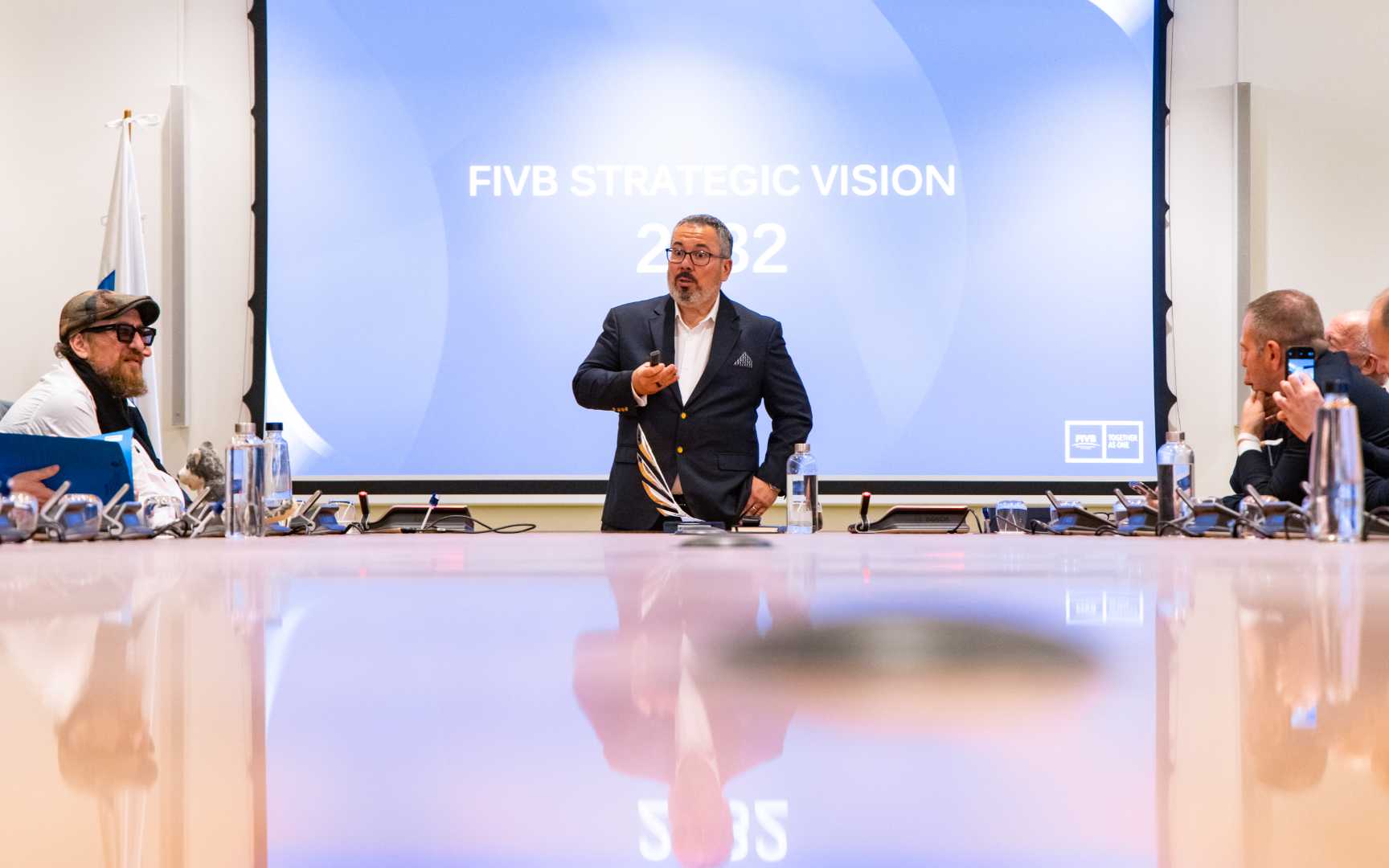
FA - Volleyball is played all over the world. Today, the FIVB is composed of 222 members, 222 countries, 222 votes: that's the FIVB General Assembly. We have some entities that we call 'PowerHouses' in the world, where volleyball is top 3 in the country, often top 1, and that would be the popular participation you mention. We can cite some: Japan, China and India in Asia; in Europe, Turkey is a superpower, as are Poland, Italy, France and Germany; in South America, we have Brazil, Argentina, Peru and Colombia; and Mexico, the United States, Canada, Cuba and the Dominican Republic in North and Central America. The point is, volleyball is played all over the world today and, according to research, we have about 800 million people who are somehow connected to volleyball. And our main metric for strategic planning, which we call “FIVB Strategic Vision 2032,” is to double that number by 2032, reaching 1.6 billion people somehow connected to our sport.
AIPS – What is the project “Where a ball is in the air, there is volleyball”?
FA - What we mean by ‘the action of keeping a ball in the air is volleyball’ is basically making the sport more accessible. So, it’s not simply high-performance sport, or the major volleyball events in the world, that should be followed and promoted, but rather any and all actions/participation in having the sport integrated into your life. That is, a boy or a girl in Rio de Janeiro playing soccer with a little sandal goal and a plastic ball, that’s soccer – it’s not just the FIFA World Cup – and perhaps no other Olympic sport has this power to combine mass participation with high performance. And that’s what we want to do. No matter what type of terrain you're playing on, no matter the time of year, no matter the temperature, no matter how many people are playing, whether there's a net or not… The action of keeping a ball in the air, keeping it moving and practicing the sport, that's volleyball. And we believe in that: volleyball has the power to unite people, to bring people together, and the values of volleyball, especially collaboration, inclusion, integration, can contribute to a better society, to a better world. That's what we believe. This year we are launching a new discipline called "Air Volleyball" inspired by a way of playing volleyball in China by literally millions of people. It's not a competition, it's not an event, it's just about making entry and access to our sport easier and getting more people, especially the new generations, to fall in love with the sport. The common mission between the IOC and the UN is to make the world a better place through sport, and we believe that we can help make the world a better place through Volleyball.
AIPS - There is a trend towards limiting the number of years a leader can be at the head of an organization. Are you in favor of this? How long do you intend to remain in charge of the FIVB?
FA - Completely in favor. Term limits and age limits are things that need to move forward, not only in sports, but in society as a whole. Here at the FIVB we follow the same cycle as the IOC: eight-year terms with a possible re-election of four years, a maximum of 12 years respecting the maximum age of 70 years. We are elected to serve the sport, we are here for a period of our lives and the mission must always be to deliver the sport better than we found it.
AIPS - When you're not traveling the world to see the evolution of volleyball, what do you like to do?
FA - Spending time with my family, my friends, sports, music, art. Volleyball, yoga, guitar, mountaineering, skiing and cycling – these are my hobbies. That's what I love to do, being with people. Lately, my schedule has been packed with all the travel and hard work at the FIVB in Lausanne, Switzerland, where I've lived with my family for 14 years. But we always find time for sports, art, music, friends, and socializing. Sports, art, and music have the unique power to inspire and move people. To make the world a better place to live in.
Cr-AIPS
Responses
Leave your comment